From atomic interactions to defect evolution.
NN-mGSF estimates the energy of coordinated slip between atomic layers. Dislocation field dynamics uses the change in energy with slip to simulate how copper twins lengthen and thicken.
 From atomic-layer energy to twin evolution
Atomic-layer slip and coupled energy
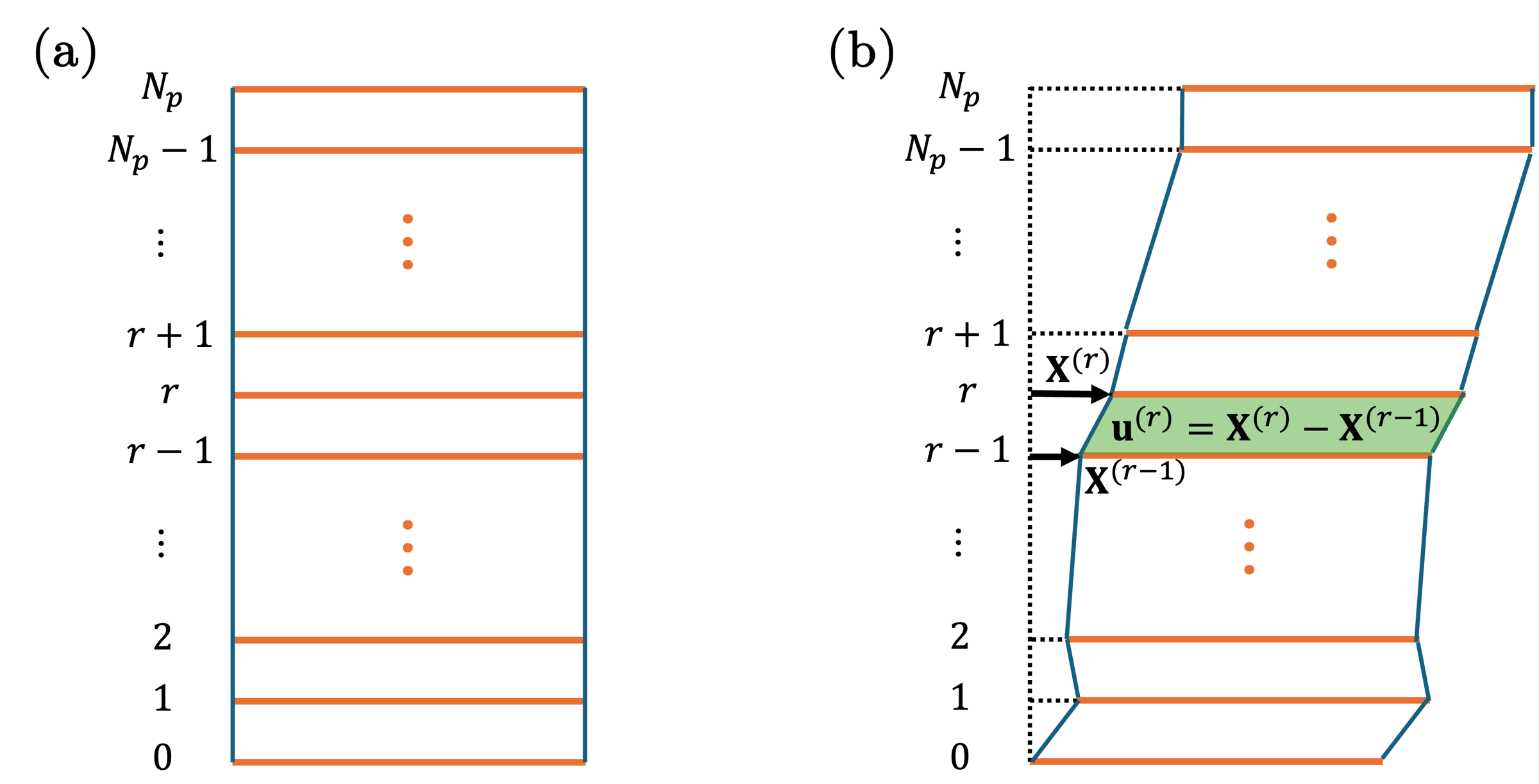
Advancing a twin interface involves coordinated slip on neighboring atomic planes. NN-mGSF maps simultaneous relative shifts to a coupled energy, retaining interactions between layers rather than treating each slip plane independently.
From coupled energy to local driving force
The energy change as one plane slips determines its local driving force, including contributions from neighboring planes.
Defect driving forces and twin evolution
DFD combines local fault energies with long-range elastic interactions to track dislocations on parallel slip planes. The copper simulations start from a prescribed twin embryo and follow its length and thickness under shear.
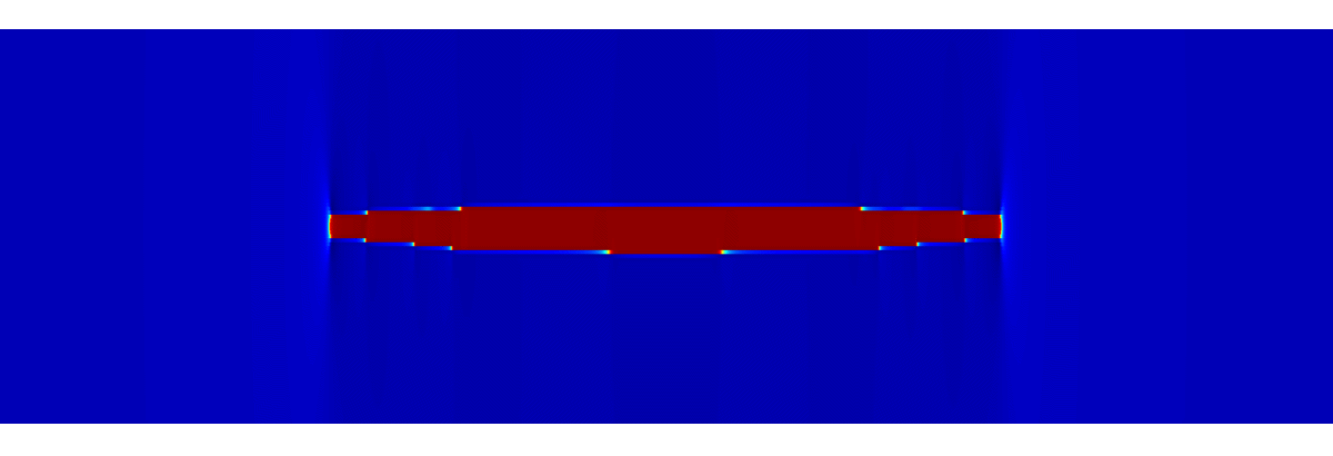
The red twin band grows from a prescribed embryo in the blue matrix.
In a copper simulation with 30 parallel (111) planes, the same embryo lengthened at 2.5 GPa applied shear stress and both lengthened and thickened at 3.0 GPa. Twinning partials formed alternately at the upper and lower coherent twin boundaries and swept along their slip planes, adding one layer at a time.
Dislocation interactions on parallel slip planes
The study checked the long-range elastic calculation against classical interaction energies for parallel straight dislocations and for dislocation loops. It then examined how two dislocation structures relaxed in copper.
- A perturbed low-angle tilt boundary formed steps, and dislocations could detach from metastable step edges.
- In model dipole-wall units representing part of a persistent slip band, dipole spacings settled around 6–7 nm in an initially flat unit. An initially wavy unit retained a wider range of spacings.
The boundary and wall calculations used single-plane fault energies calibrated against atomistic simulations. The twin calculations used NN-mGSF to capture short-range coupling between neighboring planes.